Docs
The MOLD whitepaper, summarised.
A plain-language summary of every section, numbered as in the whitepaper. New to the words Pour, Break or grain? The glossary at the end explains each in a line.
Abstract
MOLD is a token standard and launchpad for Robinhood Chain in which a token’s rules are scheduled rather than fixed. At Pour the creator commits to the complete path of every rule (fees, limits, locks, rewards and creator powers) from the first block to a final frozen state. Contracts carry that path out with no admin key. Each holding also keeps a short history, called grain, so a rule can treat a two-day holder differently from a two-month holder in the same trade.
The aim: protect buyers when protection matters, step aside when it does not, and show every future change before the first purchase.
1. Introduction
New-chain launches follow a familiar pattern. Snipers and bots crowd the first blocks, so creators add heavy fees and wallet caps. Weeks later those same rules hold back ordinary trading, and the creator must either leave them in place or keep an admin key to change them.
Fixed rules suit only one moment in a token’s life. An admin key asks holders to trust that every change will be fair. MOLD’s answer is a third path: decide the whole future up front, publish it on chain, and give up the power to change it.
2. Why Robinhood Chain
- An EVM-compatible Ethereum Layer 2 on the Arbitrum stack, with ETH for gas (chain ID 46630).
- Launchpads and memecoins were among its first visible activity: the market MOLD is built for.
- Blocks about every 100 ms, so a schedule can step almost continuously; a sniper fee can fall second by second.
- Chainlink price feeds were live at mainnet, so a mold can read market prices without its own oracle.
- Robinhood Wallet supports the chain and bridges from other networks.
- Molds are Solidity, tested and audited with standard tools. Robinhood runs the sequencer; MOLD does not rely on any chain incentive program.
3. Design goals
- Commitment. Every rule change a token will make is fixed and public at Pour.
- No keys. Nobody, creator or MOLD team, can alter a sealed schedule.
- Fairness by behaviour. Rules can depend on what a holder did, such as how long they held.
- Bounded effect. A rule never takes more than the amount moved, and every cut goes to a named place or is burned.
- Gifts are free. Plain wallet-to-wallet transfers can be exempt; fees apply to swaps.
- Composability. Tokens stay ERC-20 compatible for wallets, explorers and other protocols.
4. The schedule model
A rule is any value the token checks during a transfer or swap. The standard set:
| Rule | Measured as | Applies to |
|---|---|---|
| Buy fee | Basis points of the amount | Swaps into the token |
| Sell fee | Basis points of the amount | Swaps out of the token |
| Sniper fee | Basis points of the amount | Buys during the opening window |
| Holder share | Share of fees | Portion of fees paid to holders |
| Burn share | Share of fees | Portion of fees removed from supply |
| Creator fee | Basis points of the amount | Paid to the creator on swaps |
| Max wallet | Share of supply | Largest balance a wallet may hold |
| Creator lock | On or off | Whether the creator wallet may sell |
Keyframes and curves
Each rule’s schedule is a list of up to 16 keyframes, each a position and a value. Between two keyframes the value follows a curve chosen at Pour: a step (hold until the next keyframe), a straight line, or exponential decay.
Clocks
Each rule picks the clock its positions are measured on: time since Pour, cumulative swap volume in ETH, the number of holders above a dust threshold, or grain, the age of the holding in the trade. Volume and holder clocks only move forward, so a schedule never steps back if activity drops.
Stages
Pour: the Foundry creates the token, seals its schedules and opens its Uniswap pool. Set: the opening window, strictest at first and then easing. Cure: the long middle, where fees and limits follow their curves and fees and limits follow their curves while the token trades. Break: the creator’s chosen end point, either a fixed date or the moment every schedule reaches its last keyframe. Remaining creator powers are revoked and values freeze; from then on the token behaves as a fixed-rule token.
5. Grain: per-holding state
Like metal that keeps a record of how it cooled, each holding keeps a grain record stored beside its balance in a single storage slot: when the wallet first held more than dust, when it last sold, its volume-weighted average buy price, and 80 spare bits for custom molds (referral codes, streaks, badges).
Age counts from the later of first-held and last-sold, so selling restarts it. Tokens moved into a wallet blend its age by amount, which stops someone buying in a fresh wallet and borrowing an old wallet’s age.
6. Architecture
Token standard
Launchpad
Uniswap v4 hook
SDK
MOLD runs no exchange of its own. At Pour the Foundry creates the token’s Uniswap v4 pool with the MOLD hook attached, places the whole supply as a one-sided position above the starting price and locks it permanently; buyers’ ETH flows into the pool as they buy, and the Foundry never holds it. On every swap the hook passes the trade to the token’s evaluate function; the token reads each rule’s current value and the trader’s grain, and returns up to three cuts plus a burn. The hook checks the total never exceeds the amount moved, takes the cuts, lets the pool trade and updates grain. Uniswap’s own liquidity-provider fee applies as on any other pool. A creator can make a dev buy in the Pour transaction; it is shown on the token page and held under the token’s creator-lock rule.
Custom molds implement one interface, are registered before Pour, and are pinned by code hash. See the five steps →
7. Ready molds
The Foundry ships five ready molds. Their values come from the whitepaper. Whitepaper valueThis value is set in the MOLD whitepaper for this ready mold.
| Mold | Schedule | At Break |
|---|---|---|
 Open Cast Open Cast | Creator fee starts 1% at Pour. Then it steps to 0% at 30 d. | The creator fee ends. |
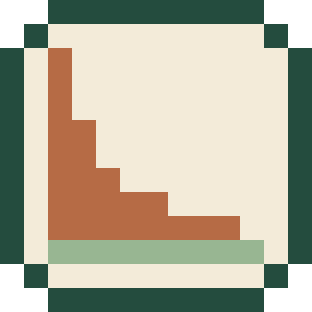 Quench Quench | Sniper fee starts 30% at Pour. Then it falls quickly, then slowly, to 0% at 1 h. | Only the Uniswap pool fee applies. |
 Slow Cure Slow Cure | Max wallet starts 1% of supply at Pour. Then it relaxes steadily to no limit at 30 d. Sell fee starts 5% at Pour. Then it falls steadily to 0% at 30 d. | No limits remain. |
 Heirloom Heirloom | Sell fee starts 0.5% at Pour. It never changes. Holder share starts 100% of fees at Pour. It never changes. | The reward rate is frozen. |
 Lost Wax Lost Wax | Creator fee starts 2% at Pour. Then it falls steadily to 0% at 90 d. Creator lock starts On at Pour. It never changes. | The creator still holds tokens but has no powers. |
8. A worked example
Two holders each sell 1 ETH worth on the same day. The rule charges 4% on holdings under 7 days, 2% from 7 to 30 days and nothing after; half goes to holders and half is burned. The Uniswap pool fee, 0.3% here, also applies.
| Holder A (2 days) | Holder B (45 days) | |
|---|---|---|
| Rule fee | 4% | 0% |
| To holders | 0.02 ETH | 0 |
| Burned | 0.02 ETH worth | 0 |
| Pool fee | 0.003 ETH | 0.003 ETH |
| Receives | 0.957 ETH | 0.997 ETH |
A fixed-rule token would charge both the same. The Grain calculator on How it works reproduces these figures.
9. Economics
MOLD has no protocol token. The protocol earns a share of rule fees, set at 20%, taken from inside the cut a rule produces rather than added on top. Uniswap pool fees go to that pool’s liquidity providers, not to MOLD, and any Foundry launch fee is itself a published schedule. Any later governance or token decision would be announced separately and could not affect sealed schedules.
10. Security and trust
- Schedules and mold code hashes are written at Pour and have no setter functions.
- Both the token and the MOLD hook enforce that cuts plus burn never exceed the amount moved.
- Core contracts start behind an upgrade key held by a named multisig until independent audits finish; the key is then renounced. Upgrades can never touch a sealed schedule.
- Every token page shows the full schedule, current stage, current values and a countdown to the next change.
- MOLD never holds user keys; every transaction appears in the user’s wallet before signing.
11. Risks
- Bugs in MOLD or in a custom mold could lose funds despite audits.
- A creator can seal an unfair or simply poor schedule. MOLD makes it visible, not good.
- Robinhood Chain’s sequencer is centrally operated; downtime or policy changes there affect MOLD.
- Some wallets and aggregators may not show fee-on-transfer behaviour clearly.
- Rules on token launches differ by jurisdiction and may change.
Glossary
- Pour · launch
- Pour is the launch: the token is created, its rules are sealed and its Uniswap pool opens, all in one transaction.
- Set · the first minutes
- Set is the opening window right after launch, when rules are at their strictest to stop snipers and bots, and begin to ease.
- Cure · the long middle
- Cure is the long middle stretch: fees fall and limits relax along the curves published at launch.
- Break · rules freeze
- Break is the end point the creator chose (a date, or when every schedule is done). After it, rules never move again and the creator has no remaining powers.
- Mold · a rule set
- A mold is a token’s set of rules and their timetable. Pick a ready-made one (Quench, Slow Cure, Heirloom…) or build your own.
- Seal · lock the rules
- Sealing locks the rules at launch. After that nobody can edit them: not the creator, not the MOLD team.
- Schedule · a rule’s timetable
- A schedule says how one rule (a fee, a limit) changes over time, trading volume or holder count, written as points on a curve.
- Grain · holding age
- Grain is how long a wallet has held a token. Some tokens charge lower sell fees the longer you hold; selling resets it.
- Foundry · the launcher
- The Foundry is MOLD’s launch contract. It creates the token, seals its rules, opens its Uniswap pool and locks the liquidity.
- Sniper fee · an early-buy fee
- A fee on buys in the first moments after launch, when bots try to buy first. It falls to zero on its schedule.
- Dev buy · the creator’s first buy
- An optional first buy by the creator, made in the same transaction as the launch, so nobody can buy before them.